TRADITIONAL CRAFTS THAT STILL ENDURE ON THE AMALFI COAST
When you think of the Amalfi Coast, postcard-perfect landscapes, yachts, and luxury hotels come to mind, along with crystal-clear waters and an almost fairy-tale-like atmosphere. But we mustn’t forget that there’s another side to the Coast—the everyday, authentic side—experienced by the locals, who share a common history and have been passing down traditions and trades for centuries. Join us as we explore the traditional crafts that still thrive today in the coastal villages!
by R. Cascone
As time has passed and new technologies and scientific knowledge have been introduced into the workforce, countless traditional trades have been lost or have evolved to adapt to today’s society and new economic demands. Others, however, continue to be practiced and are essential because they represent a tangible link between a place’s inhabitants and its history. But which ancient professions still endure today on the Amalfi Coast? Getting to know them means discovering a side of the Amalfi Coast that goes beyond the postcard image: not merely a tourist destination, but a living region shaped by the labor of entire generations.
share this article
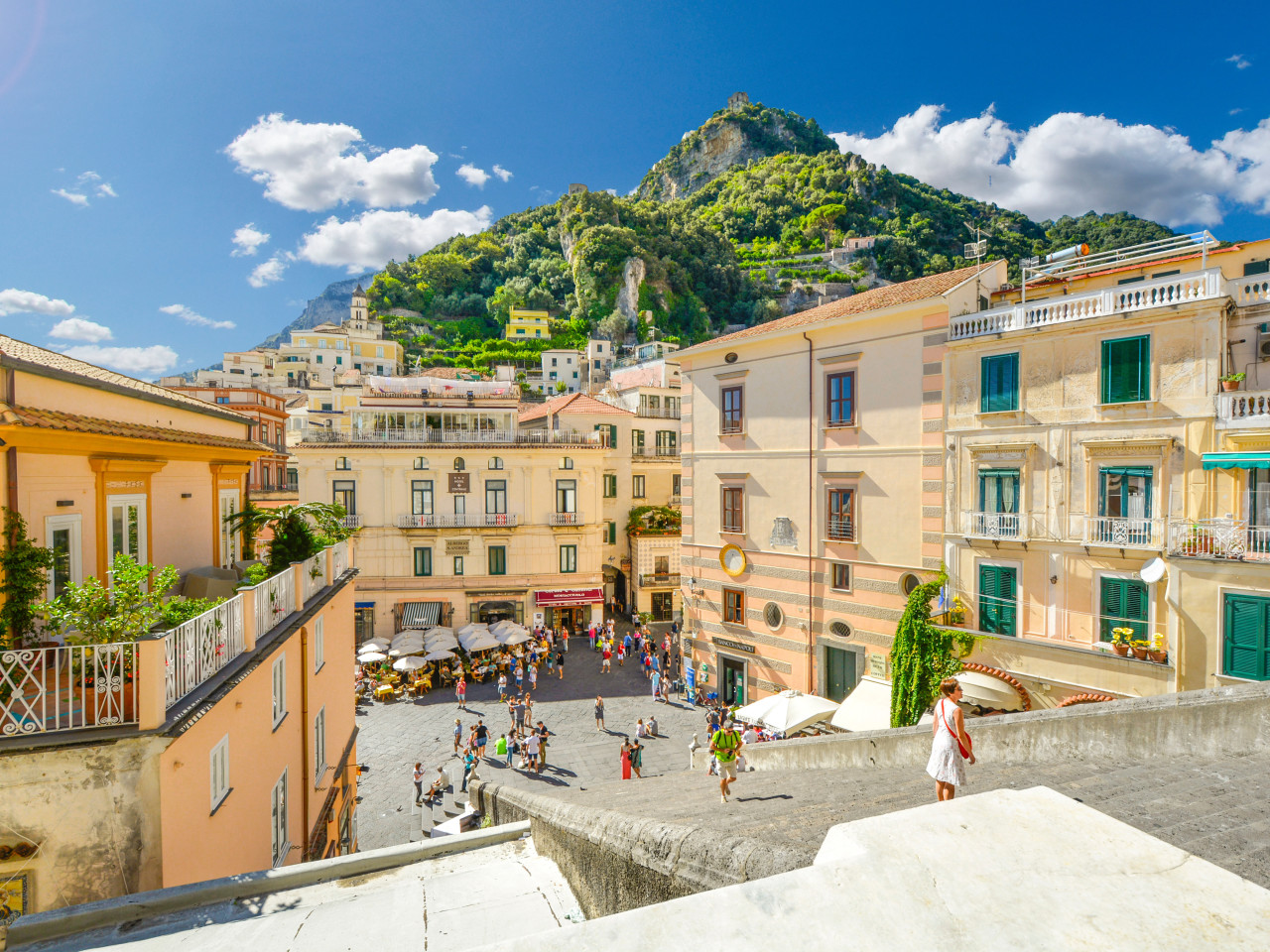
"Piazza Duomo" in Amalfi
Lemon cultivation and the terraced landscape
One of the Amalfi Coast’s most iconic products worldwide is the lemon. The variety grown in this region is called “sfusato,” due to its tapered shape, and has even been awarded PGI (Protected Geographical Indication) status. Lemon growers, therefore, remain vitally important to the Amalfi Coast, and the lemon groves themselves have become one of the region’s most distinctive features. The trees grow on terraced land, built along the mountain slopes and supported by dry-stone walls. The use of terraced land is so important to the Amalfi Coast that it has become one of the reasons for its inclusion on UNESCO’s list of “World Heritage Sites,” as we explained in this article.
In short, even today, lemon cultivation requires knowledge that is passed down from generation to generation: from pruning to irrigation, from protecting the trees to harvesting. The work of the lemon grower is, therefore, still essential to the Amalfi Coast: without it, the very essence of the region would undergo radical changes and even suffer damage, both in terms of its image and its economy.

The practice of terracing: a craft that protects the land
We already know that terraces are essential for farming on the Amalfi Coast, whether for lemons, vineyards, or other agricultural products. Alongside the farmers, there are also other professionals who care for the agricultural landscape, since the construction and maintenance of dry-stone walls require extensive experience, knowledge of the materials and the terrain, and extreme precision. The coastal area, characterized by steep slopes descending to the sea, cliffs, and coves, is truly one of a kind. Precisely for this reason, it requires a high level of highly specialized expertise to ensure that farming activities do not damage the landscape and that there is no risk of landslides or soil erosion. The stones of the dry-stone walls are arranged to create sturdy structures without the use of mortar, enabling them to support the soil on the slopes and thus create arable land in places where it would naturally be impossible to grow anything. It is, therefore, an ancient tradition designed to maintain the balance of a landscape characterized by steep slopes. For this reason, the workers who build and repair the terraces and dry-stone walls also contribute to the preservation of the Amalfi Coast’s cultural landscape.
Fishermen: the case of Cetara
Fishing has always been one of the most widespread and significant activities on the Amalfi Coast. In particular, the village of Cetara is a place where the connection between work and the sea plays an even more prominent role in culture and society. Here, in fact, there is a very long tradition of fishing, which has shaped the local economy and culture for centuries. Anchovy fishing, in particular, is a hallmark of the village of Cetara: even today, events are organized in its honor, such as the much-loved “Notte delle Lampare” (Night of the Lampare). Here, too, there is a supply chain built on knowledge, equipment, and techniques for preserving and processing raw materials—and, consequently, a range of traditional trades linked to all these stages that still endure today, even though they have obviously adapted to new technologies and to the economic and environmental changes in the region.

Anchovies' colatura: culinary knowledge
You’ve surely heard of Cetara’s colatura di alici, one of the Amalfi Coast’s most iconic products worldwide, which has also been awarded the DOP designation. This flavorful, amber-colored sauce is the result of an ancient method of preserving anchovies in salt, a process that requires time, care, and very specific techniques. Making colatura isn’t just a matter of following a recipe; it’s the result of artisanal expertise passed down from generation to generation for centuries, in which the key lies in knowing how to combine the raw ingredients, salt, and all the maturation processes. The result is that one of the oldest food preservation methods is used to create a unique culinary specialty, recognized worldwide as a delicacy.

The masters of Amalfi paper
Anyone visiting Amalfi is bound to come across one of the shops selling truly unique stationery. This is because the production of fine Amalfi paper is one of the area’s longest-standing artisan traditions. The history of Amalfi paper is linked to the ancient paper mills that once harnessed the local waterways (we’ve also written about this here). Even today, there are still a few artisanal workshops that continue to produce paper using traditional methods: you can recognize it because each sheet is unique and features slight variations in texture and surface. It is precisely these imperfections that make Amalfi paper so highly prized; it is used primarily for wedding invitations, art prints, and other high-end products.

Ceramic artists
When you walk into a souvenir shop on the Amalfi Coast, you can’t help but notice the abundance of colorful ceramic items. Ceramic craftsmanship is, in fact, another hallmark of the region’s coastal artisanal tradition, with a very long history behind it. The true coastal capital of ceramics is Vietri sul Mare, where even today you’ll find workshops producing all kinds of ceramic items using traditional methods. The Solimene ceramics factory is a perfect example: located at the entrance to the town, it’s a truly unique building designed by architect Paolo Soleri, who incorporated decorations and entire walls made of colorful ceramics into the factory’s architecture—a real feast for the eyes! The most common items are kitchenware, from plates to glasses, but paintings, vases, and decorative objects are also very popular… in short, if you’re looking for a souvenir to take home, you’ll have a vast selection! But ceramics aren’t just found in shops—far from it! In every coastal village, majolica-tiled domes in a myriad of colors and geometric patterns rise high above the town. Here, too, the connection between craftsmanship and landscape is very close, because one has enriched the other, making it recognizable around the world.

Tailoring and "Moda Positano"
Positano’s international fame is also linked to a tailoring tradition that has come to be known as “Moda Positano.” This term refers to a particular style of clothing—usually summerwear—characterized by lightweight garments, natural fabrics, and vibrant colors, designed specifically for life by the sea. Artisanal workshops and small tailor shops have worked for decades to make Positano fashion one-of-a-kind, and even today, when visiting the village, you can’t help but notice the many boutiques and their storefronts filled with colorful linen garments—perfect for beating the summer heat.

Shoemakers and the handcrafted sandals
Another craft that endures on the Amalfi Coast despite competition from industrial production and low-cost products is that of the shoemaker. You’ve surely noticed, alongside the clothing stores, the shops selling handmade sandals, where the distinctive scent of leather reigns supreme. Handmade sandals are among women’s favorite items: comfortable, stylish, and durable, they’re the choice for those who want to take home from the Amalfi Coast not just a simple souvenir, but a unique product crafted by the skilled hands of artisans who have been working with these materials their entire lives.
A heritage at risk
All the crafts I’ve told you about are ancient and invaluable to the history and culture of the Amalfi Coast. They represent a true heritage that must be protected, but this is not always an easy task. Many of these activities require a significant investment of time, effort, and knowledge, which often clash with high costs, industrial competition, and the difficulty of finding young people interested in carrying on traditional jobs. For this reason, passing down these skills from one generation to the next is essential to the survival of these crafts. When a craft disappears, in fact, it’s not just a profession that’s lost, but a part of that region’s culture. Preserving them, therefore, means protecting more than just a tradition: it means striving to keep the identity of the Amalfi Coast intact.
- If you’d like to learn more about how Amalfi paper is made, you can always visit the Paper Museum! There, you can learn more about the production processes and even make your own sheet of paper. Click here to learn more.
- What are the most beautiful majolica-tiled domes on the Amalfi Coast? You’ll find them all here!
- Shopping on the Amalfi Coast is a real experience. Here are all our tips on the subject.
fun facts
share this article


Travelmar Ferries
Discover the Amalfi Coast from the sea: more views, less traffic.
Daily Ferry Tours
Visit Amalfi, Positano and other destinations in just one day.

Reach your destination on comfortable buses with reserved seats.
latest articles
TRAVEL AMALFI COAST
privacy & cookies | p.iva 07294870634 | Travel Amalfi Coast by Tra.Vel.Mar SRL. All right reserved