THE HISTORY OF THE MARITIME REPUBLIC OF AMALFI
There’s a reason why Amalfi gave its name to the entire Coast. Its history is one of great power and prestige: for centuries, Amalfi was one of the most important Maritime Republics, a key player in Mediterranean trade and a crossroads of Eastern and Western cultures. Discover this magnificent past with us!
by R. Cascone
There was a time when Amalfi, along with Pisa, Genoa, and Venice, dominated international trade. The Republic of Amalfi, which later became known as the Duchy of Amalfi, was, in fact, one of the major powers of the Mediterranean during the Middle Ages. It’s no coincidence that its coat of arms is still featured on the flag of the Italian Navy! Dive into history with us: you’ll discover a truly fascinating side of Amalfi!
share this article
Amalfi
From its origins to the Middle Ages
The city’s origins are partly shrouded in legend: according to tradition, Amalfi was founded by the Romans in the 5th century A.D., but the first reliable historical records date back to the Early Middle Ages. It was during this period that the Duchy of Naples transformed the village into a fortress to defend itself against the invasion of Alboin’s Lombards. Thanks to its strategic location, nestled between the mountains and the sea, Amalfi gained great importance during the conflict between the Byzantines and the Lombards. However, the duchy did not prevent Amalfi from enjoying autonomy, which allowed for significant growth in trade. It was around the year 839 that Amalfi was conquered by the Lombard prince Sicardo, but immediately after his assassination, the people of Amalfi declared their independence from the Lombards. Later, to defend itself against the expansionist policies of the Arabs, Amalfi joined the Campanian League alongside Gaeta and Sorrento, and was able to defeat the Saracens in the famous Battle of Ostia in 849. Meanwhile, Amalfi continued to expand its trade relations with Arab, Sicilian, and Spanish merchants, following the rules set forth in the Tavole Amalfitane, the oldest maritime statute in Italian history!
The Maritime Republic and the Norman Period
Between the 9th and 11th centuries, Amalfi reached the height of its splendor, becoming a true Maritime Republic, albeit under Norman rule. In fact, the Norman government did not hinder the city’s economic growth; on the contrary, new overland trade routes were opened, and the city’s industries flourished, such as paper production and wheat processing in mills. Furthermore, Amalfi’s ships carried spices, fine fabrics, and other goods from the Byzantine Empire, North Africa, and the Middle East, effectively making Amalfi one of the wealthiest cities of the era and also contributing to the spread of ideas, knowledge, and technological innovations.

The decline of the Republic
Although Amalfi had lost its political independence under Norman rule, it was the Suebians who also stripped it of the economic independence it had enjoyed. Furthermore, throughout the 10th century, Amalfi suffered various attacks from its rival republic, Pisa, until, in 1137, Pisan troops succeeded in sacking the city. Finally, a catastrophic natural disaster dealt Amalfi the final blow: the harbor was destroyed by a devastating tsunami in 1343, marking the end of the city’s maritime power.

What remains of a glorious past
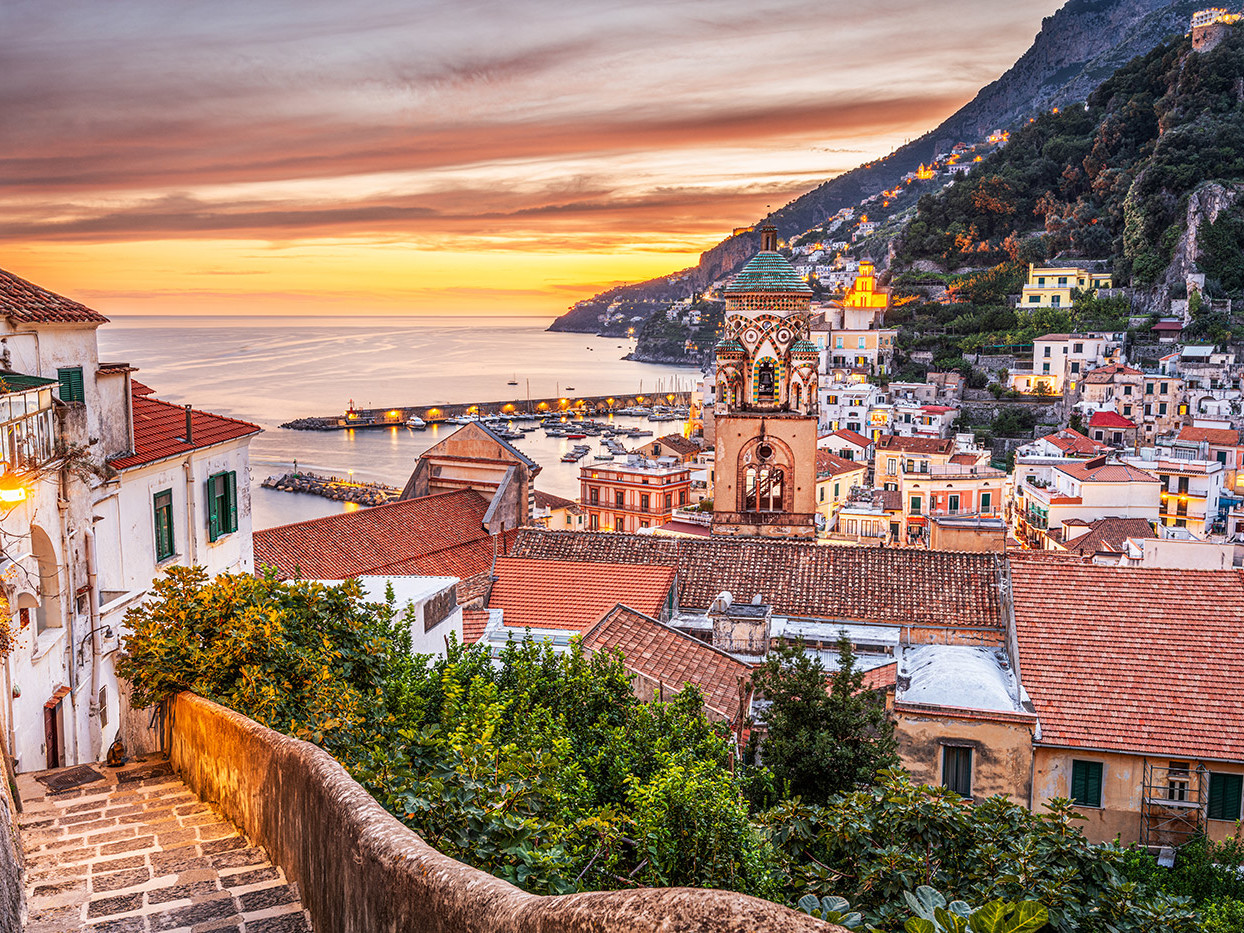
Today, Amalfi is still considered the main city of the Amalfi Coast, which takes its name from it. The memory of a powerful and glorious past, however, remains alive: the town jealously preserves the traces of its ancient grandeur through monuments, museums, and traditions. Its architecture is tangible proof of this: the Neo-Moorish style of the Cathedral, in fact, reflects the influences that the Arabs, Normans, and Byzantines had on the city. Furthermore, every four years, the city participates in the Regatta of the Ancient Maritime Republics, a historical event that still pits Amalfi, Pisa, Genoa, and Venice against one another and is deeply cherished by the local population. Finally, most of the historical artifacts from the city’s golden age are on display at the Museo della Bussola (The Compass Museum), located inside the Republic Ancient Arsenal: a must-see for all history buffs!
share this article
- The Amalfi Tables are one of the most important contributions of the Maritime Republic of Amalfi to the history of navigation. They contained a set of regulations governing maritime trade, the rights of crews, contracts, and port activities. For this reason, they symbolize the exceptionally high level of economic development achieved by the city of Amalfi during its golden age.
- The Regatta of the Maritime Republics remains one of the favorite historical events among locals and tourists alike! You can read more about it here.
- Legend has it that the compass was invented by Flavio Gioia, a native of Amalfi… but this belief likely spread due to a misinterpretation of a Latin text! The invention of the compass is, in fact, attributed to the Chinese, who also discovered the existence of the Earth’s magnetic field.
fun facts

Travelmar Ferries
Discover the Amalfi Coast from the sea: more views, less traffic.
Daily Ferry Tours
Visit Amalfi, Positano and other destinations in just one day.

Reach your destination on comfortable buses with reserved seats.
latest articles
TRAVEL AMALFI COAST
privacy & cookies | p.iva 07294870634 | Travel Amalfi Coast by Tra.Vel.Mar SRL. All right reserved